Your website is often the first meaningful interaction someone has with your business. Before calling, visiting or requesting a quotation, potential customers may use it to decide whether you appear credible, relevant and easy to deal with.
For Huddersfield businesses, an effective website needs to do more than look attractive. It should clearly explain what you offer, work reliably on different devices and make the next step straightforward.
This checklist covers the essential features worth reviewing, whether you are planning a new website or improving an existing one.
Jump To
- Clear Contact Information
- Mobile-Friendly Design
- Speed And Reliable Performance
- Simple Website Navigation
- Helpful Website Content
- Local SEO Foundations
- Clear Calls To Action
- Reviews And Trust Signals
- Accessible Design
- Security, Privacy And Maintenance
- Your Final Website Checklist
Clear Contact Information
Visitors should not have to search through several pages to work out how to contact you. Include your main telephone number or enquiry link in a prominent position, with further information in the website footer and on a dedicated contact page.
Depending on how your business operates, useful contact details may include:
- Your telephone number and email address
- A straightforward enquiry form
- Normal opening or response hours
- Your business address, if customers visit your premises
- The areas you serve if you travel to customers
- Directions or an embedded map where genuinely helpful
Home-based and service-area businesses may not want to display a private address. In that case, clearly stating the towns or postcodes you cover can be more useful to visitors.
Mobile-Friendly Design
Your website should be comfortable to use on mobile phones, tablets, laptops and larger desktop screens. Responsive design allows the layout to adjust to the available screen rather than forcing mobile users to zoom or scroll sideways.
A good mobile experience includes:
- Text that can be read without zooming
- Buttons and links that are easy to tap
- Menus that open and close reliably
- Forms that are practical to complete on a phone
- Images that resize without obscuring the page
- The same important information and functions available across devices
Google generally uses the mobile version of a website’s content for indexing. However, mobile-friendly design is not a shortcut to higher rankings. Its main purpose is to give visitors a consistent, usable experience wherever they view the site.
Speed And Reliable Performance
A slow or unreliable website can lose a visitor before they have seen what your business offers. Performance is particularly important for people browsing on mobile connections.
Common improvements include:
- Compressing images and using suitable formats such as WebP
- Removing plugins and scripts that are no longer needed
- Using caching appropriately
- Choosing hosting suited to the website’s size and traffic
- Checking for broken features after updates
A content delivery network may help some websites, especially those serving visitors across different regions, but it is not necessary for every small business site. Start by measuring the actual problem rather than adding tools without a clear purpose.
Google’s Core Web Vitals can help identify loading, responsiveness and layout issues. Good scores support a better experience, although they do not guarantee a particular search position.
Simple Website Navigation
Visitors should be able to understand your website structure quickly. A crowded menu, unclear page names or several competing buttons can make even a visually impressive website frustrating to use.
Most business websites benefit from:
- A concise main menu with familiar page names
- Separate pages for important services
- A clear route back to the homepage
- Relevant links between related pages
- A visible contact option
- A footer containing useful supporting links
Search functionality can help larger shops, directories and content-heavy websites. A small brochure website may not need it if the navigation is already clear.
Helpful Website Content
Good website content answers the questions a customer is likely to ask before contacting you. It should explain what you provide, who it is for and what someone can expect when they make an enquiry.
Your core pages should cover:
- The services or products you provide
- The customers and locations you serve
- How your process works
- Relevant timescales, options or pricing information
- Common questions or concerns
- Why your experience is relevant to the customer’s needs
A useful About page can introduce the people behind the business, while service pages should provide enough detail to help visitors decide whether your offering is suitable. Blog articles can then explore specific questions without overloading your main pages.
Review written content regularly so that old offers, discontinued services and incorrect contact details do not remain online.
Local SEO Foundations
If you mainly work with customers in Huddersfield and the surrounding area, your website should make that connection clear. Mention locations naturally where they are relevant, but avoid forcing the same place name into every paragraph.
Useful local foundations include:
- Consistent business details across your website and trusted listings
- A properly maintained Google Business Profile
- Accurate descriptions of the areas you genuinely serve
- Individual location pages only when each page provides useful, distinct information
- Locally relevant examples, projects or customer stories
Our guide to local SEO for Huddersfield businesses looks at these areas in more detail.
Clear Calls To Action
A call to action tells visitors what they can do next. The right wording depends on your service, so avoid promising a free consultation, immediate response or no-obligation quotation unless that is genuinely what you provide.
Appropriate examples might include:
- Request A Quotation
- Arrange An Appointment
- Ask Us A Question
- View Our Services
- Browse The Product Range
Place calls to action where they make sense, such as after explaining a service or answering an important question. Visitors should feel guided rather than pressured.
Reviews And Trust Signals
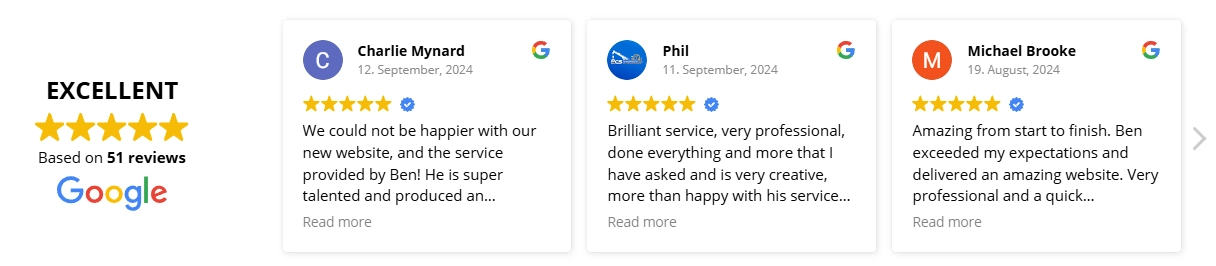
People want evidence that a business can deliver what it promises. Genuine customer feedback, project examples and clear business information can help them make a more informed decision.
Depending on your business, useful trust signals could include:
- Specific and authentic customer testimonials
- Case studies showing the work completed
- Images of real projects, products or team members
- Relevant qualifications or memberships that can be verified
- Clear terms, delivery information or cancellation policies
Do not create testimonials or imply that an accreditation applies if it does not. When publishing identifiable customer details, photographs or feedback, make sure you have permission to use them.
Accessible Design
An accessible website is easier for more people to use, including visitors with visual, hearing, mobility or cognitive impairments. Many accessibility improvements also make the website clearer for everyone.
Important considerations include:
- Sufficient contrast between text and its background
- Descriptive alternative text for meaningful images
- Form fields with visible and understandable labels
- Navigation that can be used with a keyboard
- Clear focus indicators for links and controls
- Headings arranged in a logical order
- Plain language and descriptive link text
Accessibility should be considered throughout the design and content process rather than treated as an optional feature added at the end.
Security, Privacy And Maintenance
An SSL certificate protects information travelling between the visitor and your website, but HTTPS alone does not make a site completely secure. Website security also depends on its hosting, software, access controls and maintenance.
A sensible maintenance plan may include:
- Regular software and plugin updates
- Secure administrator accounts and passwords
- Tested website backups
- Security monitoring and spam protection
- Checks for broken links and forms
- Renewal monitoring for domains and certificates
If you are reviewing where your site is hosted, find out more about our website hosting service.
Your website should also provide suitable privacy information when it collects personal data through contact forms, bookings, analytics or mailing lists. Visitors need to understand why their information is being collected, how it is used and how long it may be retained.
Non-essential cookies should not be placed before the visitor has made an appropriate choice. The exact requirements depend on the technologies and data processing used, so avoid assuming that installing a generic cookie banner automatically makes a website compliant.
Your Final Website Checklist
Before publishing a new website or approving a redesign, check that:
- Contact details are accurate and easy to find
- Important pages work properly on mobile devices
- Forms have been tested and reach the correct inbox
- Navigation and page names are easy to understand
- Services, locations and business information are current
- Calls to action reflect what you genuinely offer
- Reviews and business claims can be supported
- Accessibility has been considered
- Backups, updates and security checks are in place
- Privacy and cookie information reflects the website’s actual setup
A business website should make it easier for potential customers to understand your services and take the next step. If yours feels outdated, difficult to use or unclear, explore our web design services in Huddersfield.
For practical advice about improving an existing website or planning a new one, contact Athena Media to discuss what your business needs.